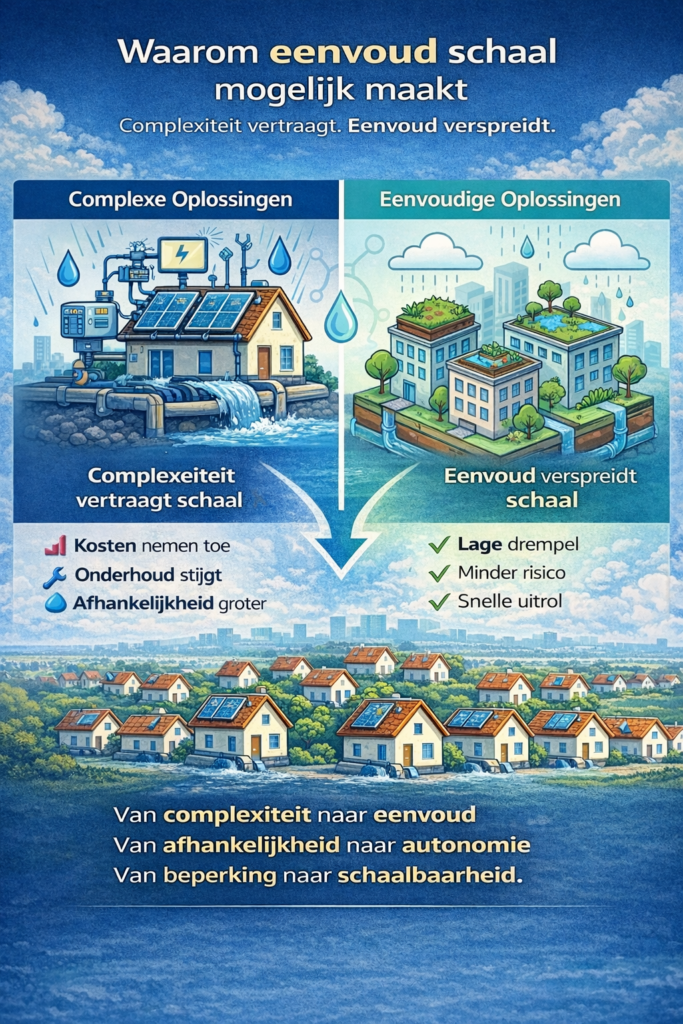
Why the best solutions are often the simplest.
Traditional water management is designed around centralized processing: discharging water as quickly as possible to a single system. But climate change is increasing the variability and intensity of rainfall, significantly increasing the burden on these centralized systems.
The reflex in technical challenges is often: more technology. More sensors. More data. More control. But when the goal is scalability, applicable to thousands of buildings, complexity often works against you instead of helping you.
The problem arises primarily at the building level. Thousands of roofs collect and simultaneously drain rainwater, causing peak loads in the sewer system.
The logical question: how do we solve this in a way that is truly scalable?
The answer isn't more complexity. The answer is less.
Why complexity is harmful
Complex solutions depend on external factors to function properly:
• Energy supply, sensors and software
• Communication and data processing
• Maintenance and specialist knowledge
Every dependency introduces a potential vulnerability. If one link fails, the entire system can be limited or interrupted. This has direct implications for scalability:
• Higher installation and maintenance costs
• Greater operational uncertainty
• Slower implementation
Scalability requires reliability, not complexity
A solution that works at scale doesn't need to perfectly optimize every technical detail. It should primarily:
• Reliable functioning without continuous intervention
• Be independent of external control
• Can be easily applied to various buildings
• Be economically feasible in broad application
Scale occurs when a solution can spread without adding additional complexity to the existing system.
Nature as a model
Rainwater management is inherently a distributed process. Rain doesn't fall in a single central location, but simultaneously on thousands of individual roofs. The system is originally:
• Distributed
• Parallel
• Autonomous
When the solution has the same properties, it can scale with the system. Simplicity that repeats itself grows naturally.
Once a solution is simple enough to be implemented everywhere, scale occurs automatically.