
Below you will find an explanation of the impact of water volumes on energy transfers.
If you close the full screen (scroll down) you can use the calculator to find specific values.
Climate change presents us with major challenges: heat stress in cities, flooding due to peak rainfall and rising energy costs for heating and cooling. The Global WCS Roof System offers an innovative solution that not only reduces your energy consumption, but also contributes to a sustainable urban climate.
The impact of water on a roof: heat loss and energy costs
Roof constructions play a crucial role in the energy management of buildings. A layer of water on a roof leads to significant heat transfer. With proper management, a layer of standing water on a roof can lead to significant desired heat transfers. We can quantify this with the following heat conduction formula.
If we make this clear, we get the picture below:
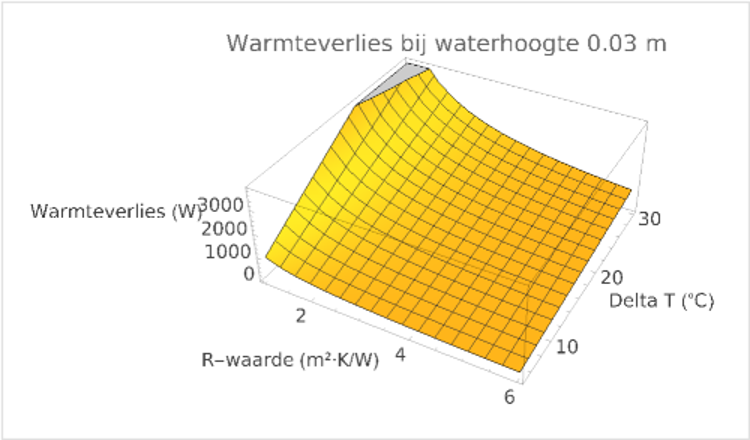
What does this analysis show?
More insulation (higher R-value) significantly reduces heat loss.
A higher water layer increases heat loss, especially with poorly insulated roofs.
Larger temperature difference (ΔT\Delta TΔT) increases the effect of water on heat loss.
Met het Global WCS Daksysteem wordt dit probleem slim beheerd:
In winter, excess water is drained away to minimize heat loss.
In the summer, a controlled water layer is used to cool the building.
Water storage prevents peak load on the sewer system and contributes to climate adaptation.