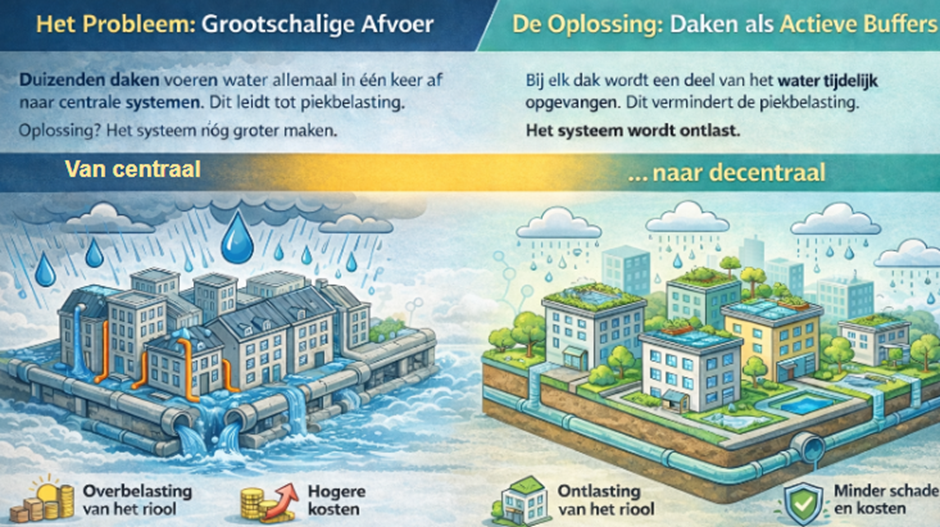
We have learned to solve water problems with large systems.
Bigger sewers. Bigger pumps. Bigger buffers.
It's a logical response: if the problem is big, we make the solution bigger.
But there is a fundamental system flaw here.
Water problems do not originate centrally.
They are created decentrally. On thousands of individual roofs, simultaneously.
The system level at which the problem arises
When rain falls, something very simple happens:
- Every roof collects water
- Every roof drains water
- Every roof does this almost simultaneously
So the sewer does not receive a continuous flow, but a sudden peak of thousands of small flows at the same time.
The sewer does not become overloaded because it is designed too small.
It becomes overloaded because all buildings behave the same way: they drain water immediately.
So the problem is not a lack of central capacity.
The problem is the lack of decentralized buffering.
Why central solutions are reaching their limits
Centralized systems work perfectly for transport, but they aren't designed to solve simultaneity. You can double the size of a sewer system, but if all roofs still discharge simultaneously, the problem just shifts. It doesn't go away. This leads to a cycle of ever-expanding infrastructure, with ever-increasing costs and ever-decreasing efficiency. Not because the technology is failing, but because the system level is chosen incorrectly.
The missing layer: the building level
The only place where simultaneity can be broken is where it originates: on the roof. When each building temporarily retains a small portion of the water, the behavior of the entire system changes:
- Peaks are being flattened
- The sewer is relieved
- Overload is prevented
Not through one large system, but through thousands of small buffers that work together.
This is not a replacement for central infrastructure.
It is the missing complement.
From scaling up to scaling up
The future of urban water management lies not only in larger solutions, but also in better distribution of responsibility across the entire system.
At Global WCS, we understand that not everything needs to be solved centrally. Some of the most powerful solutions are small, local, and simple. And they start on the roof.