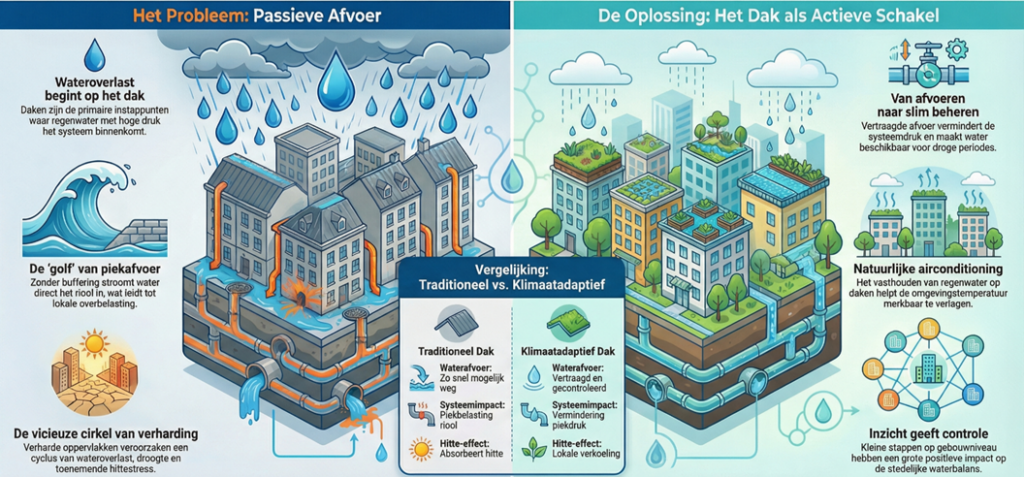
Water on the roof: a simple phenomenon, with complex consequences. When rain falls, it seems simple: water comes, water goes. But due to the combination of increasingly extreme showers and more and more paving in urban environments, rainwater ends up in systems that are not made for it. Too fast, too much, too abrupt.
What really happens to that water?
Peak flow
During heavy rain showers, an extremely large amount of water reaches the roof at the same time in a short period of time. This not only causes a peak in discharge, but also a 'wave' that falls. Without buffering, this water goes directly into the sewer, which leads to overloading of the drainage system and risk of local flooding.
Pavement and scale levels
As a result, we see a recurring cycle of: too much water in too short a time (flooding), then too little water over long periods (drought) and also too much heat on paved surfaces (heat stress).
Te veel water in te korte tijd (wateroverlast), dan te weinig water over lange periodes (droogte) en bovendien te veel hitte op verharde oppervlakken (hittestress).
Building level as a starting point
It all starts on the roof. If no effective buffering takes place there, the rest of the system – sewage, soil, urban heat balance – will follow immediately. Roofs without smart rainwater storage therefore not only cause water drainage, but contribute to the broader problem of water balance in the construction environment.
Why is this relevant for you as a roof manager?
If you already invest in solar panels or infrastructure on your roof, you know how important a well-functioning roof is for lifespan, performance and maintenance costs. But rainwater also plays a role there: not only as a burden, but also as an opportunity;
- It can help lower heat stress when temporarily retained and drained slowly.
- It can reduce the pressure on sewers through controlled drainage.
- It makes the water available for later use in dry periods.
This requires a change of perspective: from draining water as fast as possible, to smart water management with the roof as a a systemfor climate adaptation